The EnergyRing Class
Back to Energy Rings Animation
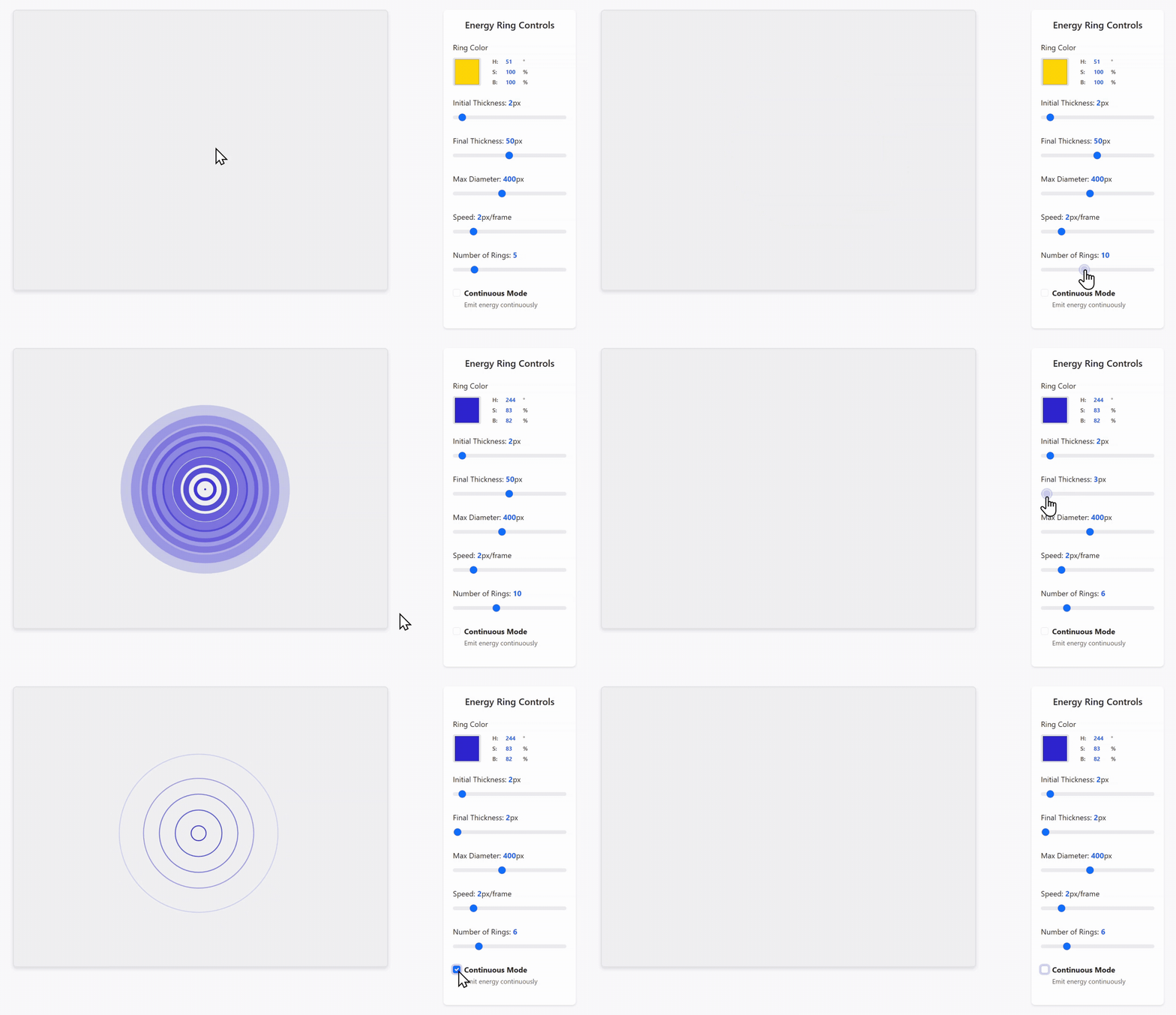
Purpose: The EnergyRing class manages a system of multiple Ring objects that spawn sequentially, creating a wave or pulse effect. This class demonstrates composition (has-a relationship) by containing and coordinating multiple Ring instances with shared properties.
Visual Example
Key Object-Oriented Programming Concepts
- Composition: EnergyRing contains an array of Ring objects (has-a relationship)
- Aggregation: Manages a collection of related objects with a common purpose
- Delegation: EnergyRing delegates drawing and updating to individual Ring objects
- State Management: Tracks complex state (spawn timing, frame counting, continuous mode)
- Conditional Logic: Different behaviors for continuous vs. normal mode
- Separation of Concerns: Ring handles individual behavior, EnergyRing handles coordination
Composition Design Pattern: Notice how EnergyRing doesn't duplicate the code from Ring. Instead, it creates and manages Ring objects, reusing their functionality. This is a powerful OOP technique that promotes code reuse and maintainability.
Complete EnergyRing Class Source Code
// ============================================
// ENERGYRING CLASS (Sequential Pulse System)
// ============================================
// This class creates and manages a system of n sequential Ring objects
// All rings share the same color and settings, creating a unified energy pulse effect
// Rings are spawned at regular intervals based on the first ring's progress
class EnergyRing {
    // Constructor - creates an energy ring system with n sequential pulses
    // Parameters:
    //   x: horizontal position on canvas
    //   y: vertical position on canvas
    //   n: number of sequential rings to create (default = 5)
    //   settings: object containing control panel settings (hue, saturation, brightness, thickness, etc.)
    constructor(x, y, n = 5, settings = null) {
        this.x = x;                         // X position for all rings
        this.y = y;                         // Y position for all rings
        this.n = n;                         // Total number of rings to spawn (in continuous mode, this is per cycle)
        this.rings = [];                    // Array to hold all Ring objects

        // Store the settings that will be used for all rings in this system
        // If no settings provided, use default values
        this.settings = settings || {
            hue: 51,
            saturation: 100,
            brightness: 100,
            initialThickness: 2,
            finalThickness: 50,
            maxDiameter: 400,
            speed: 2,
            continuousMode: false
        };

        // Track which rings have been spawned in the current cycle
        // We start by spawning only the first ring
        // Additional rings spawn as the first ring progresses
        this.ringsSpawned = 0;

        // In continuous mode, track total rings spawned across all cycles
        this.totalRingsSpawned = 0;

        // Track frames since last spawn for continuous mode timing
        // This provides consistent spawn intervals regardless of ring removal
        this.framesSinceLastSpawn = 0;

        // Immediately create the first ring to start the sequence
        this.spawnRing();
    }

    // Spawn a new ring with the shared settings
    // This method is called initially for the first ring,
    // then called repeatedly by update() as previous rings progress
    spawnRing() {
        // In continuous mode, always spawn new rings
        // In normal mode, only spawn up to n rings
        if (this.settings.continuousMode || this.ringsSpawned < this.n) {
            // Create a new Ring at the center position with shared settings
            this.rings.push(new Ring(this.x, this.y, this.settings));

            // Increment the counter to track how many rings we've created in this cycle
            this.ringsSpawned++;
            this.totalRingsSpawned++;
        }
    }

    // Update method - called each frame to manage all rings in this system
    update() {
        // Update all existing rings in this energy system
        for (let ring of this.rings) {
            ring.update();
        }

        // Increment frame counter for timing
        this.framesSinceLastSpawn++;

        // Check if we should spawn the next ring in the sequence
        if (this.rings.length > 0) {

            if (this.settings.continuousMode) {
                // In continuous mode, use frame-based timing for consistent spawning
                // Calculate how many frames should pass between each ring spawn
                // This is based on: (total frames for one ring to complete) / (number of rings per cycle)
                let framesForFullExpansion = this.settings.maxDiameter / this.settings.speed;
                let framesPerRing = framesForFullExpansion / this.n;

                // Spawn a new ring when enough frames have passed
                if (this.framesSinceLastSpawn >= framesPerRing) {
                    this.spawnRing();
                    this.framesSinceLastSpawn = 0;  // Reset the counter
                }
            } else {
                // In normal (non-continuous) mode, use progress-based spawning
                // Get the progress of the very first ring (index 0)
                // This is our "leader" ring that determines when others spawn
                let firstRingProgress = this.rings[0].getProgress();

                // Calculate the threshold for spawning the next ring
                // When n=5 and we've spawned 1 ring, next spawns at 1/5 progress (0.2)
                // When n=5 and we've spawned 2 rings, next spawns at 2/5 progress (0.4)
                // When n=5 and we've spawned 3 rings, next spawns at 3/5 progress (0.6)
                // When n=5 and we've spawned 4 rings, next spawns at 4/5 progress (0.8)
                // This creates evenly-spaced sequential pulses
                let spawnThreshold = this.ringsSpawned / this.n;

                // If the first ring has reached or passed the threshold, spawn the next ring
                // Only in normal mode - don't spawn more than n rings
                if (firstRingProgress >= spawnThreshold && this.ringsSpawned < this.n) {
                    this.spawnRing();
                }
            }
        }

        // Clean up rings that have finished expanding
        // Loop backwards so we can safely remove items while iterating
        for (let i = this.rings.length - 1; i >= 0; i--) {
            if (this.rings[i].isFinished()) {
                this.rings.splice(i, 1);
            }
        }
    }

    // Display method - draws all rings in this energy system
    display() {
        // Simply display each ring that exists in this system
        for (let ring of this.rings) {
            ring.display();
        }
    }

    // Check if this entire energy ring system has finished
    // Returns true only when:
    //   1. All n rings have been spawned (not in continuous mode)
    //   2. All spawned rings have finished expanding and been removed
    // In continuous mode, this never returns true because rings keep spawning
    isFinished() {
        // In continuous mode, never finish
        if (this.settings.continuousMode) {
            return false;
        }

        // In normal mode, finish when all rings are spawned and removed
        return this.ringsSpawned >= this.n && this.rings.length === 0;
    }
}
Instance Variables (Properties)
| Property | Type | Description |
|---|---|---|
x |
Number | X coordinate for all rings in this system |
y |
Number | Y coordinate for all rings in this system |
n |
Number | Total number of rings to spawn per cycle |
rings |
Array<Ring> | Collection of Ring objects being managed (composition) |
settings |
Object | Configuration object shared by all rings |
ringsSpawned |
Number | Count of rings spawned in current cycle |
totalRingsSpawned |
Number | Total count across all cycles (for continuous mode) |
framesSinceLastSpawn |
Number | Frame counter for timing in continuous mode |
Methods (Behaviors)
| Method | Returns | Description |
|---|---|---|
constructor(x, y, n, settings) |
- | Initializes the energy ring system and spawns the first ring |
spawnRing() |
void | Creates a new Ring object and adds it to the rings array |
update() |
void | Updates all rings, manages spawning timing, and removes finished rings |
display() |
void | Delegates display to each Ring in the collection |
isFinished() |
Boolean | Returns true when all rings are spawned and removed (false in continuous mode) |
Example Usage
// Create settings object with energy ring configuration
let energySettings = {
    hue: 200,              // Blue color
    saturation: 80,
    brightness: 90,
    initialThickness: 2,
    finalThickness: 40,
    maxDiameter: 500,
    speed: 3,
    continuousMode: false  // Normal mode: spawn 5 rings then stop
};

// Create a new EnergyRing instance at position (300, 250)
// with 5 sequential rings
let myEnergyRing = new EnergyRing(300, 250, 5, energySettings);

// In the animation loop:
function draw() {
    background(0, 0, 94);

    myEnergyRing.update();      // Update all rings and spawn timing
    myEnergyRing.display();     // Draw all rings

    // Check if energy ring system is finished
    if (myEnergyRing.isFinished()) {
        console.log("All rings have completed!");
    }
}
Relationship Between Ring and EnergyRing
Has-A Relationship: EnergyRing has Ring objects (stored in the
Why use composition?
rings array).Why use composition?
- Code reuse: Ring's behavior doesn't need to be rewritten
- Single Responsibility: Ring handles individual animation, EnergyRing handles coordination
- Flexibility: Can easily change how rings are spawned without modifying Ring class
- Modularity: Each class has a clear, focused purpose