

Hints:
This image was inspired by the dice arrangement below.
To show that our TNTDie class would generate all dice values in [1,6] we added additional dice beyond those shown in the picture.
Some standard TNT shapes were used: TNTRoundedRectangle and TNTDisk.
Features:
| Comments: |
We used this challenge to do the legwork toward making a TNTDie shape for our library. Here's the code that created the images above:
//colors:
var dieGreen = new TNTColor(0, 139, 109, "dieGreen");
var dieRed = new TNTColor(254, 53, 24, "dieRed");
var dieWhite = new TNTColor(250, 250, 255, "dieWhite");

var center = new TNTPoint(-5, -2);
var greenDie = new TNTDie(center, 2, .3, dieGreen, white, null, 30, 6);
greenDie.drawTNTDie(context);

center = new TNTPoint(-1, 4);
var whiteDie = new TNTDie(center, 4, .2, dieWhite, black, blackStroke, 45, 2);
whiteDie.drawTNTDie(context);

center = new TNTPoint(5, -4);
var redDie = new TNTDie(center, 8, .1, dieRed, dieWhite, null, -15, 5);
redDie.drawTNTDie(context);

center = new TNTPoint(-7, 7);
var blueDie = new TNTDie(center, 3, .4, blue, white, null, 5, 1);
blueDie.drawTNTDie(context);

center = new TNTPoint(6, 6);
var blackDie = new TNTDie(center, 6, 0, black, white, null, 55, 3);
blackDie.drawTNTDie(context);

center = new TNTPoint(-7, -6);
var goldDie = new TNTDie(center, 4, .5, gold, white, null, -20, 4);
goldDie.drawTNTDie(context);
The 8 parameters for the TNTDie class are a center, a side length, a 'radiusFactor' (for the rounded effect: it's multiplied times the side length in code), a fill color, a 'pip' color, a stroke, a rotation (in degrees) and a value on the die. The development of the TNTDie class was done in stages:
All the initial work was done with a 0° rotation. The rotation about the center of the various pips was made easier with work from the phenomenal site DancesWithCode. Also, notice that the pip sizes were scaled by the overall size of the die. We calculated the diagonal of the die and used trial and error to see what size pip was needed based on the base rounded rectangle. In this fashion, the pips scale to the size of the die. We varied the sizes of the dice above to demonstrate how well the process works! |
|---|---|
| Even More: |
Some dice we rounded up at the TNT Lab! 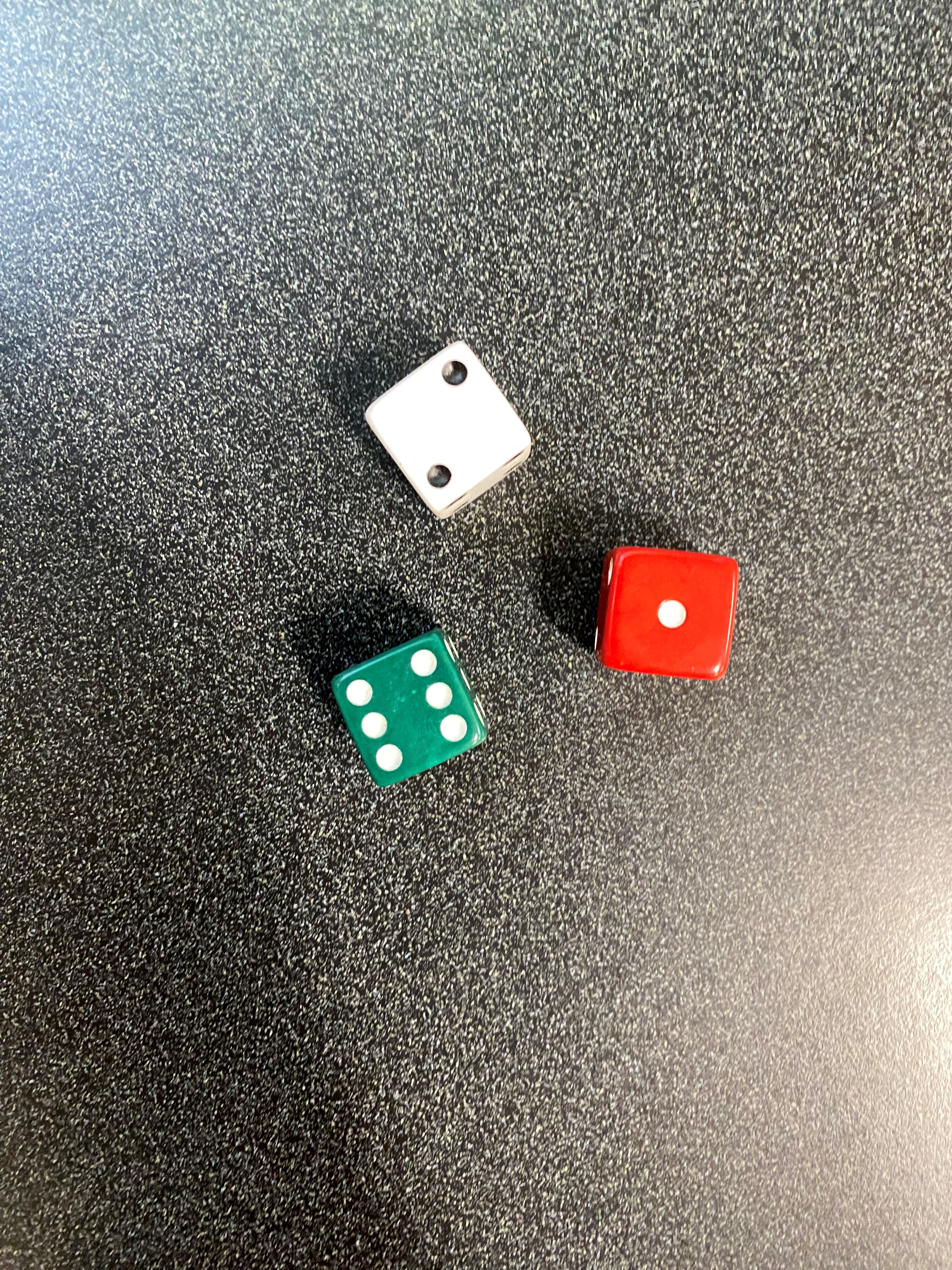
|