The Mathematician’s Mambo — what’s going on?
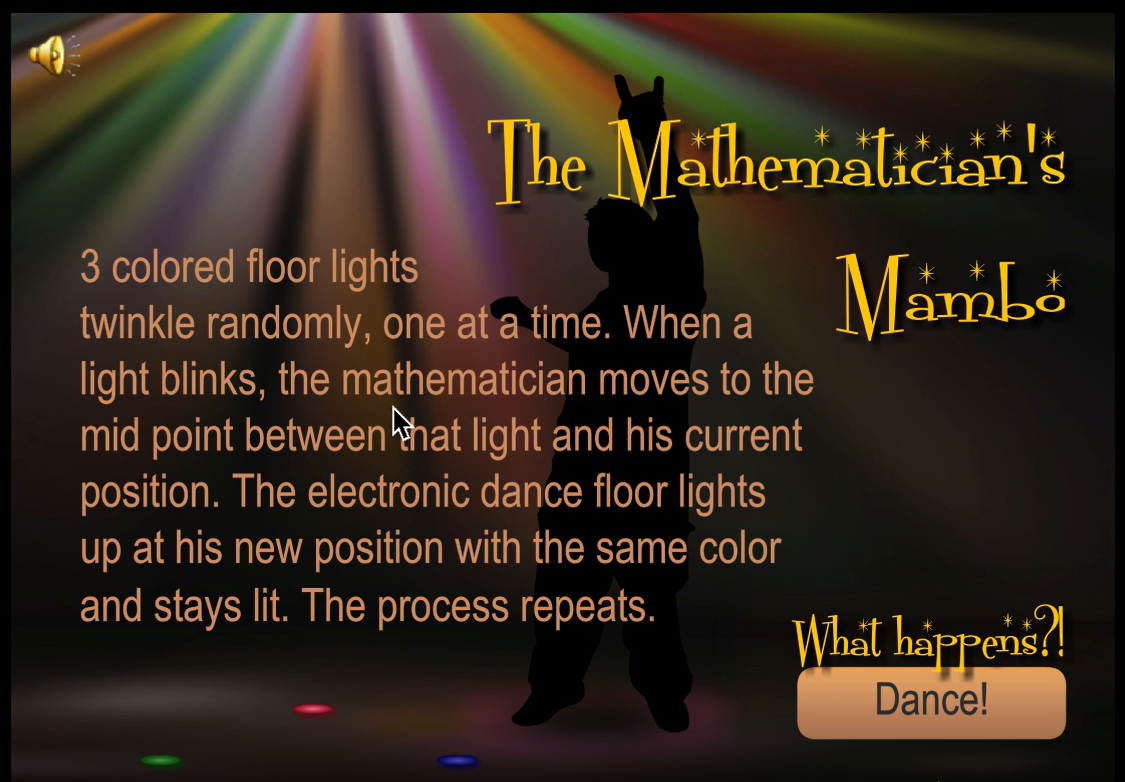
This animation was originally built in Adobe Flash around 2011 as a classroom
demonstration for TNT’s early programming courses. Because Flash was
discontinued in 2020, the original .swf file no longer runs in any
modern browser — so what you’re watching is a screen recording
captured before Flash went dark.
The premise is deceptively simple: three colored floor-lights are placed at the corners of a triangle on a dance floor. A mathematician stands somewhere on the floor. At each beat:
- One of the three lights blinks at random.
- The mathematician moves halfway to that light.
- The dance floor lights up at his new position in the blinking light’s color — and stays lit.
Repeat… tens of thousands of times. What do you expect? A random smear of colored dots? That’s the intuition — and it is spectacularly wrong.
What actually emerges is the Sierpiński Triangle — one of the most famous fractals in mathematics — assembled, dot by dot, from pure randomness. The mathematician never follows a script; chaos writes the pattern for him.
Run the Math Mambo Saga — Stage 4 →
Movie clip is only available in larger viewports.
On some mobile devices, rotating to landscape will allow viewing.
The Original Flash Animation (screen recording, c. 2011)
The Music: “Boogie Fever” — The Sylvers (1976)
The Sylvers were a family group from Los Angeles — ten siblings ranging in age from toddler to teenager — who became one of the defining acts of mid-’70s soul and funk. Their biggest hit, “Boogie Fever,” was written and produced by Freddie Perren and Kenny St. Lewis and released in early 1976. The irresistible groove climbed all the way to #1 on the Billboard Hot 100 in March of that year, spending one week at the top and becoming a signature sound of the disco era.
The song’s playful hook and rolling bass line made it the perfect soundtrack for a mathematician who just… can’t stop dancing.