Financial Equations
The formulas behind all four calculators — verified with a TI graphing calculator TVM solver.
Personal Finance Equations
The equations of personal finance are a bit complicated because they involve many variables and conditions. Unless you are dealing with simple interest, they are based on exponential growth, which alone makes them somewhat nasty.
All equations have been field-tested with the TVM app in the TI graphing calculator family. Numworks also features a free online financial calculator in its Solver area — when using it, money out of your pocket is negative; money into your pocket is positive.
Click any equation to enlarge it.
| Concept | Equation | Comment(s) |
|---|---|---|
 Savings
|
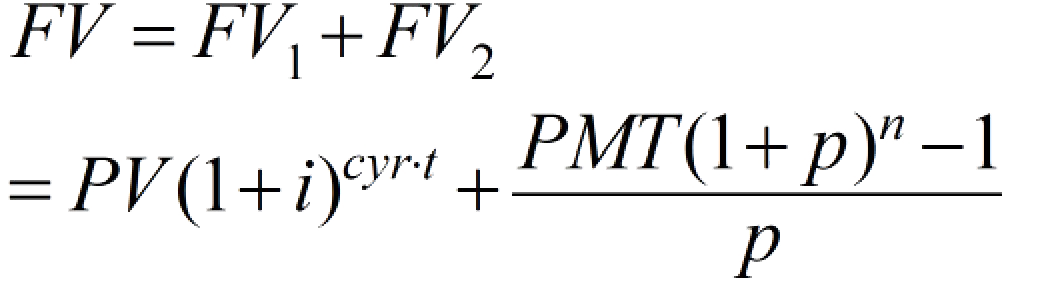 |
FV1 contributes value due to compounding of the principal value. FV2 contributes value due to compounding of regular payments. |
 Loan
Loan
|
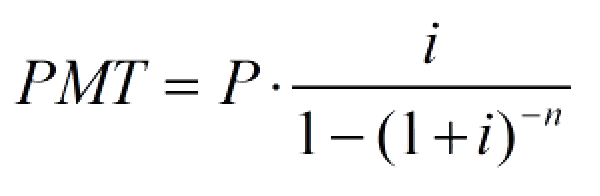 |
Currently, this app assumes both monthly payments and compounding. |
 Sinking Fund
|
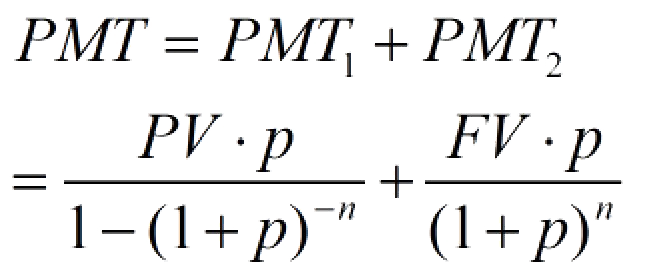 |
PMT1 contributes value based on PV (principal value); PMT2 contributes value based on FV. |
 Annuity
|
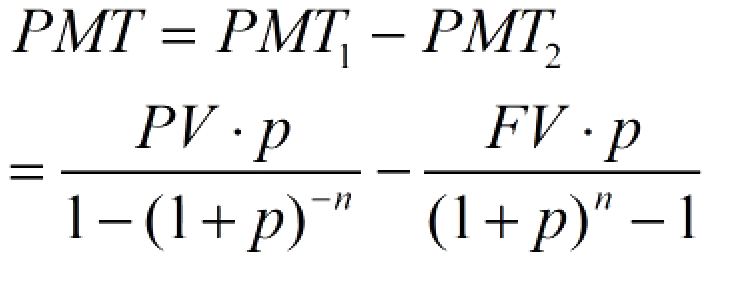 |
PMT1 is based on PV; PMT2 is based on FV.
PMT2 is subtracted because if FV > 0, that money remains in the account and
therefore does not contribute to the regular payments received during the annuity term.
Pro tip: set FV = PV and the money will never “drain” — PMT becomes perpetual! |
| Concept | Symbol | Comment(s) |
|---|---|---|
| Principal | P | The lump-sum amount invested or saved. Often synonymous with PV in these apps. |
| Present Value | PV | Current value of a future sum or stream of cash flows at a given rate of return (Investopedia). May be synonymous with P. |
| Annual Percentage Rate | r | Annual interest rate expressed as a decimal. Interest is either the fee charged for use of borrowed money or the dividend paid for use of your money. |
| Investment time (years) | t | Length of time the investment or loan is in play. |
| Regular periodic payment | PMT | Regular payments made to reduce debt or increase investment value. |
| Payments per year | pyr | Frequency of payments. Commonly 12 (monthly), 4 (quarterly), or 1 (annually). |
| Compoundings per year | cyr | Frequency at which interest is applied. Commonly 1 (annually), 4 (quarterly), or 12 (monthly). |
| Future Value | FV | Money expected in the future as a result of P, r, t, and PMT interacting. |
To simplify the equations for programming — especially when p/y and c/y differ — three intermediate variables are introduced:
| Symbol | Definition |
|---|---|
| i | APR ÷ Compoundings per year: r / cyr (source variable: myI) |
| c | Compoundings per year ÷ Payments per year: cyr / pyr (source variable: littleC) |
| p | (1 + i)c − 1 — uses i and c above (source variable: littleP) |
| n | t · pyr — total number of payments in the time interval |
Equation Detail
